
The Jane Eyre Corset
Last year I was lucky enough to be one of around 150 people worldwide chosen to take part in the Corset Renewal Challenge, organised as part of Circular Fashion Week at Leeds University. The brief was simple: some unwanted modern corsets had been diverted from landfill, and the designers and makers taking part were challenged to transform their corset in any way they wanted, as long as it remained wearable and they only used materials they already had in their stash.

Although I am no fashion historian, I am interested in the history of fashion and have watched enough YouTube videos to know that the popular conception of corsets — particularly Victorian corsets — as being highly restrictive and damaging to women’s health is far from the truth. While a few fashionistas were prepared to go to extreme lengths for the sake of fashion (so nothing has really changed there), for the most part the design of dresses, with their full skirts, created the illusion of a smaller waist. There is even some evidence of Victorian photographs being edited to further reduce the apparent waist size.
Most women needed an undergarment that was comfortable to wear all day, every day — something supportive that laid the foundation for the fashionable silhouette while gently smoothing and flattering the natural body shape, rather like the control underwear of today. These everyday corsets would, over time, mould themselves to the wearer, but more importantly, because they were laced, they could adapt to the normal monthly fluctuations in a woman’s body, as well as supporting her through the early stages of pregnancy.
It was this idea of foundation and support that I decided to use as the basis of my design. I wanted to explore the way Jane Eyre’s character and beliefs shape her and give her the resilience she needs throughout her journey, while also showing how those beliefs are themselves moulded by her experiences.

I started by rereading Jane Eyre, as well as watching a television adaptation, so that I could focus on the themes I wanted to explore. Luckily, I have a well-stocked studio full of all kinds of paper and cardboard, as well as the old books I use for my jewellery, and this came in very handy. I also enjoyed the opportunity to try out new paper-crafting techniques alongside including my much-loved origami roses.
For the base, I used paper from an old copy of Jane Eyre, which I treated using the traditional Japanese momigami technique. This involves applying a paste to the paper and then repeatedly crinkling and opening it out so that it develops a fabric-like texture. I then cut the pieces to size and as it was too difficult for me to stich this on, I used glue.
I covered the boning of the corset, in tea-stained pieces of paper on which I had written quotes from Jane Eyre about her character and beliefs. Finally, for this first stage, I folded enough origami roses and leaves to cover the top edge of the corset.
I then had to decide exactly what I wanted the design to focus on and which aspects of the book I wanted to include. I had so many ideas at this point that it took quite a while to reduce them down into something that felt clear without becoming confusing. In the end I decided my focus would be the large Chestnut tree.

This is the tree beneath which Rochester and Jane finally declare their love for one another and where Jane agrees to marry him. The scene is one of intense happiness, but it is also a portent of sorrow and anguish, because later that day the tree is struck by lightning, split in two and burnt.
The front of my corset therefore represented the chestnut tree in all its glory, with green leaves and even the tiny moth that Rochester draws Jane’s attention to. For the branch, I coloured Japanese rice paper, then crumpled and shaped it to create the twisting form of the tree. For the leaves, I stripped away one layer from corrugated cardboard, painted it and cut it into shape.

The back of the corset was then perfect for showing the blackened tree split into two parts. At this point the old tree becomes a sign of new beginnings as flowers begin to grow beneath it and sheltered by it. Just as it is beneath this tree that Jane and Rochester become engaged, it is also beneath the same tree that they are reunited as the novel reaches it’s conclusion.

Jane Eyre is so much more than simply a romantic story. It is the story of a strong, independent young woman who not only knows her worth but also remains true to her values and faith. Some parts are not easy to read from a 21st century perspective, particularly the treatment and fate of Bertha Rochester, and for anyone who wants to see part of the story retold through her eyes, I would highly recommend Wide Sargasso Sea by Jean Rhys.
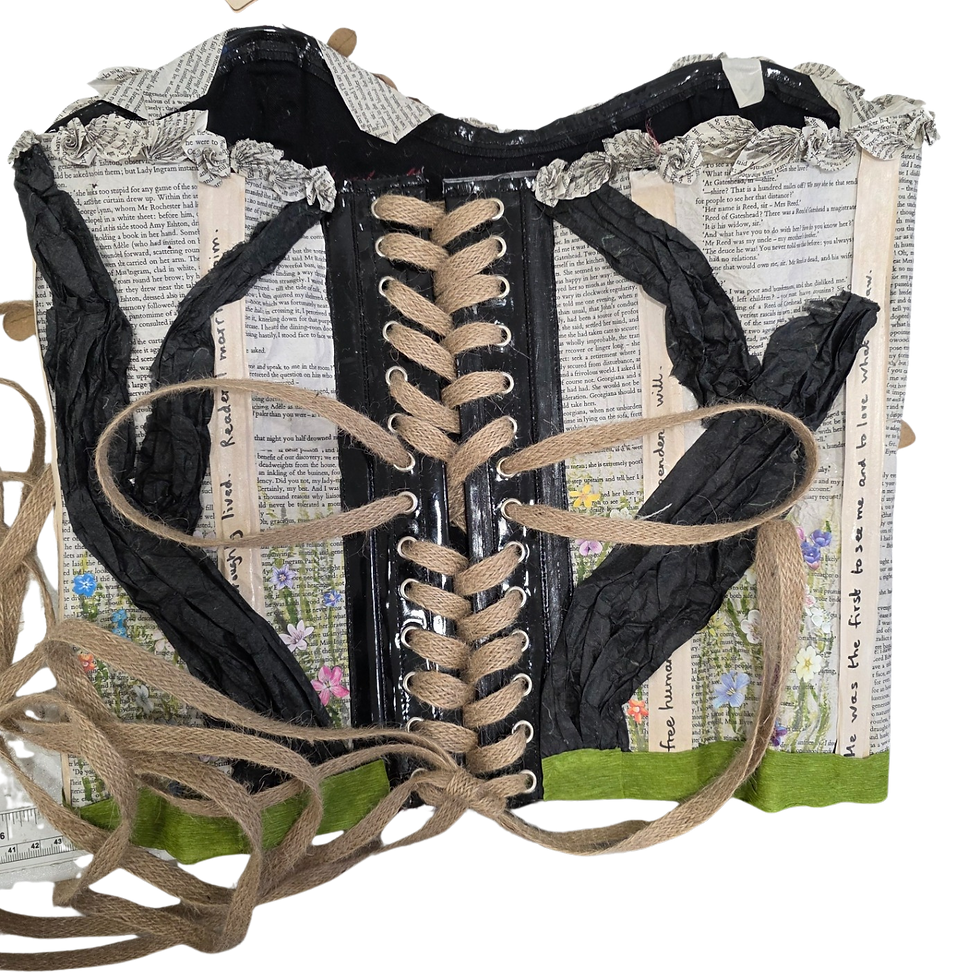
So that is Jane Eyre: the story of the corset.
I absolutely loved making it — not only the challenge of designing it but also working out how to achieve the effects I wanted, and which materials would work best. Best of all, for me, was that it came out looking almost exactly as I had imagined it.
It has also left me with a strong desire to continue pushing myself as a paper artist, and I am excited to see where that leads me.
I am still hoping to get a picture of it modelled but I do have an AI image - in real life corsets were always worn over a shift, not as shown here.


Comments